Google Ads Got More Expensive. Lead Volume Softened. Here’s Why.
You open your performance report and something looks off: Cost per click is climbing. Leads are trending down. Showroom traffic feels lighter. You search your own dealership name and don’t immediately see your ad.
It’s easy to assume something broke.
It didn’t.
What you’re seeing is the collision of three things happening at once: rising Google Ads costs, predictable seasonality in discretionary equipment buying, and a search results page that no longer looks the way it did a year ago.
Let’s unpack what actually changed — and what powersports, marine, and outdoor power equipment dealers can realistically do about it.
“My ads are running… so where are the leads?”
On paper, Google Ads looks straightforward: choose keywords, write ads, set a budget, collect leads. In reality, it’s a live auction that never stops moving.
Demand fluctuates. Competitors shift budgets. Google releases new formats. Automation reshuffles where ads appear.
When cost per click goes up and leads go down, it’s rarely a single bad setting. It’s usually several forces converging at once.
Leads getting harder to earn from paid search? The State of the Dealer: 2026 shows what top dealers do on-site to convert the traffic they already have — without spending more on ads. Download the free report.
What Actually Changed
CPC Rose While Demand Cooled
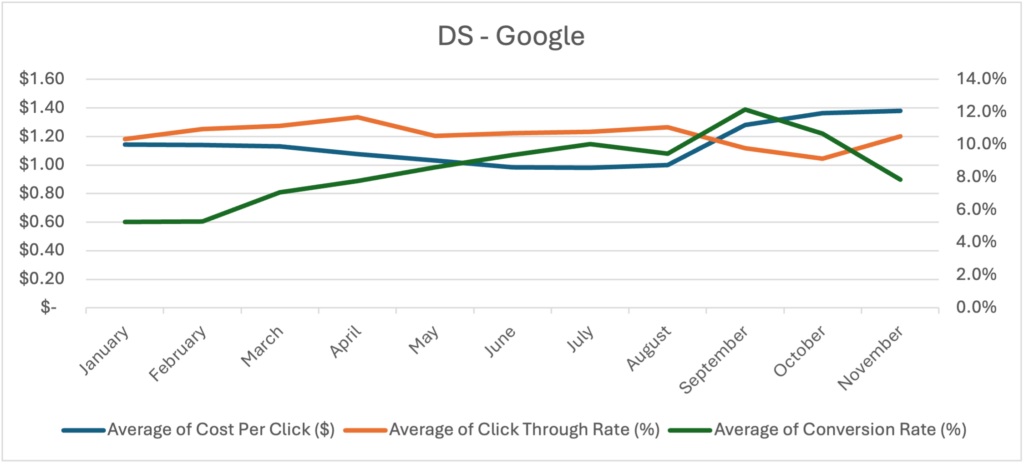
Beginning mid-year, Google Ads costs began trending upward while shopper demand softened due to normal seasonality and broader economic cooling.
Across Dealer Spike accounts through November 2025, the averages look like this:
- Google Search CPC: ~$1.14
- Google Search conversion rate: ~8.5%
When cost per click rises while fewer shoppers are actively searching, you end up paying more to reach a smaller pool of ready-to-buy buyers. Even well-built campaigns can feel expensive during these stretches.
This pattern isn’t unique to any single category. Broader Google Ads CPC inflation has been widely documented, but seasonal industries feel the impact faster and more sharply.
Seasonality Amplified the Pain
Dealers in these categories already know the rhythm:
- Riding and boating interest peaks in warmer months
- Late fall and winter bring slower shopper activity
Historically, cost per click tends to peak near year-end and soften in early summer. When higher CPCs collide with slower demand, performance drops feel dramatic — even if nothing is technically “wrong.”
You’re not just paying more. You’re paying more during a slower buying window.
AI Overviews Changed the Search Results Page
Google’s rollout of AI Overviews has fundamentally reshaped search results.
Instead of a clean stack of ads followed by organic listings, many searches now open with a large AI-generated response. The downstream effects are real:
- Fewer prominent ad slots
- Less predictable placement
- More competition for the premium real estate that remains
This is less about campaign quality and more about real estate scarcity. When there’s less space to appear, advertisers pay more to stay visible.
Automation Is No Longer Optional
Performance Max is Becoming Foundational
Performance Max now runs across Search, YouTube, Display, Discover, Maps, and more. Google continues pushing advertisers toward automation, while slowly adding more transparency.
Performance Max works best when it has solid inputs:
- Clean inventory feeds
- Accurate pricing
- Strong creative assets
- Reliable dealer data
- Prior audience exposure from awareness channels
Performance Max doesn’t create demand on its own. It amplifies existing demand when the groundwork has already been laid.
Inventory-Based Ads are Gaining Importance
For equipment dealers, inventory-driven formats are increasingly powerful.
When configured correctly, these ads:
- Show real units with pricing
- Connect shoppers directly to specific inventory
- Reach buyers further along in the decision process
They are highly effective at capturing intent — but they still rely on shoppers already being in-market.
The Core Issue: Too Much Weight at the Bottom of the Funnel
Many dealers concentrate most of their spend on Search, inventory-based ads, and Performance Max.
That approach works well when demand is strong.
When demand softens:
- Search auctions tighten
- Cost per click rises
- Click volume drops
- Leads slow
Search captures demand. It does not create it.
A bottom-funnel-only strategy runs out of people to talk to when fewer shoppers are actively searching.
In our on-demand webinar, The High-Performance Recipe: Digital Marketing That Fills Your Lot, Bill Koehn and Hayley Hollen walk through three real dealer scenarios and show exactly what a full-funnel paid strategy looks like when it’s built to fit your market. Watch it on demand today!
How Channels Actually Work Together
Awareness: Display and Social
These channels put your dealership and your inventory on the radar well before someone is ready to search.
Think of them as the “plant the seed” channels. They introduce your brand, your inventory, and the ownership experience long before a buyer types a high-intent query.
Across Dealer Spike accounts through November 2025, the averages look like this:
- Facebook CPC: ~$0.32
- Facebook conversion rate: ~0.58%
These campaigns are not designed to convert at the same rate as Search. Their role is to influence buyers earlier in the journey and shape future search behavior — a dynamic supported by broader paid media benchmarks comparing Facebook and Google performance.
Without this early influence, bottom-funnel campaigns are forced to carry the entire load on their own.
Demand: Video and mid-funnel campaigns
Video and demand-focused campaigns help shoppers move from casual interest to serious consideration.
Examples include:
- Walk-arounds of popular side-by-sides or personal watercraft
- Educational content on choosing horsepower, attachments, or accessories
- Ownership stories from real customers
The goal is familiarity and confidence, not instant form fills.
Conversion: Search, Performance Max, Inventory Ads
These channels catch shoppers who are ready to act.
They perform best when the buyer has already seen your dealership earlier in their journey.
Why Leads Dropped
Put together, the picture becomes clear:
- Cost per click increased
- Shopper demand softened
- AI Overviews reduced traditional ad space
- Automation shifted where ads appear
- Many dealers leaned too heavily on conversion-only tactics
Your campaigns didn’t fail. The environment changed.
What Dealers Can Do
Stop Treating Every Month Like Peak Season
Your marketing mix should shift with the calendar.
- Slower months: prioritize visibility and demand-building
- Stronger months: lean harder into Search, Performance Max, and inventory-based ads
You already plan inventory seasonally. Marketing deserves the same treatment.
Use Lower-Cost Clicks to Support Higher-Cost Ones
When awareness clicks cost a fraction of Search clicks, it makes sense to start relationships earlier and let Search finish them later.
The leads still come — they just arrive with less friction.
Data Quality Matters More Than Ever
Automation only works as well as the inputs behind it.
Accurate inventory, clear pricing, strong visuals, and consistent landing pages directly affect results across Performance Max and inventory-driven campaigns.
Shoppers expect transparency. Anything less slows conversion.
Read Performance in Context
Instead of asking only “What did my cost per lead do?” also ask:
- Is overall market demand down?
- Are CPCs rising across channels?
- Are awareness efforts supporting lower-funnel performance?
Sometimes the issue isn’t execution. It’s timing.
The Bottom Line
Power sports, marine, and outdoor power dealers aren’t dealing with broken Google Ads accounts.
They’re navigating:
- Higher market-wide CPCs
- Predictable seasonality
- A search page reshaped by AI
- Automation-driven ad formats
- Over-reliance on bottom-funnel tactics
Search is still where ready-to-buy shoppers raise their hand. It just can’t carry the entire strategy on its own in softer markets. The game didn’t break. The rules changed.
Dealers who balance awareness, demand, and conversion — and adjust that balance as the season changes — will be better positioned when the next wave of buyers enters the market.
Read Next: Your 2026 Digital Game Plan
If rising CPCs and softer lead counts have you rethinking your paid media strategy, you’re not alone. Paid search still plays a major role, but a broader digital foundation matters more than ever—from accurate listings and transparent pricing to coordinated email and ads that tell one consistent story.
For a step-by-step framework you can use this year, don’t miss our 2026 Digital Game Plan for Dealers. It walks through the essentials every dealer should tune up—from SEO and automated email workflows to strategic ad planning and inventory alignment—so your online presence works as hard as you do.