There’s a unit on your lot right now that came in during spring. It’s been marked down once. Your team walks past it every day.
Among the fastest-turning dealers in The State of the Dealer: 2026, only 20.92% of inventory is 90 days or older. They don’t get there by pricing lower than you. They get there by catching that unit in week five instead of month four.
Why is used inventory where the margin lives in 2027?
Something unusual is happening in the used market, and it changes how you should think about buying.

Normally, when supply drops, prices climb. Right now, supply has fallen hard, and it starts close to home:
- Powersports dealers are running with 14.4% fewer units on hand year over year.
- Marine dealers have seen new unit inventory drop 20.8% per dealer.
- High-horsepower tractor inventory down 16.71% year over year in June, trending down for 13 straight months.
- Heavy construction fell 10.45% year over year in August. Used heavy-duty trucks sat 36% below year-ago levels in July.
- By August sleeper trucks were down 42.3%.
Under the old rules, asking prices should be spiking. They aren’t, at least not in proportion. High-horsepower tractor asking values were essentially flat, off 0.56% year over year. Construction asking values were down 1.55%. Truck values did tick up in August, but a few points of movement is not what a 40% inventory drop would normally produce. Buyers are capped by interest rates and cautious capital budgets, and that ceiling holds even when there’s nothing on the lot to sell them.
Here’s what that means practically: you cannot price your way out of a bad buy. The spread has to be earned when you acquire the unit, because the retail market won’t hand it to you later.
For recreational buyers, the response to tighter supply and higher rates is to move from new to used, where the loan is smaller and the upfront cost is lower. That shift is the reason used deserves more of your attention than it got two years ago.
And the margin math favors it. A new unit arrives with its margin already compressed by the OEM invoice, freight, prep, and advertising fees. A used unit’s margin comes down to two decisions you control: what you paid, and how you priced it.
For 2027, the constraint moves from selling to sourcing. The rest of this guide starts there.
How can your website help you source used inventory?
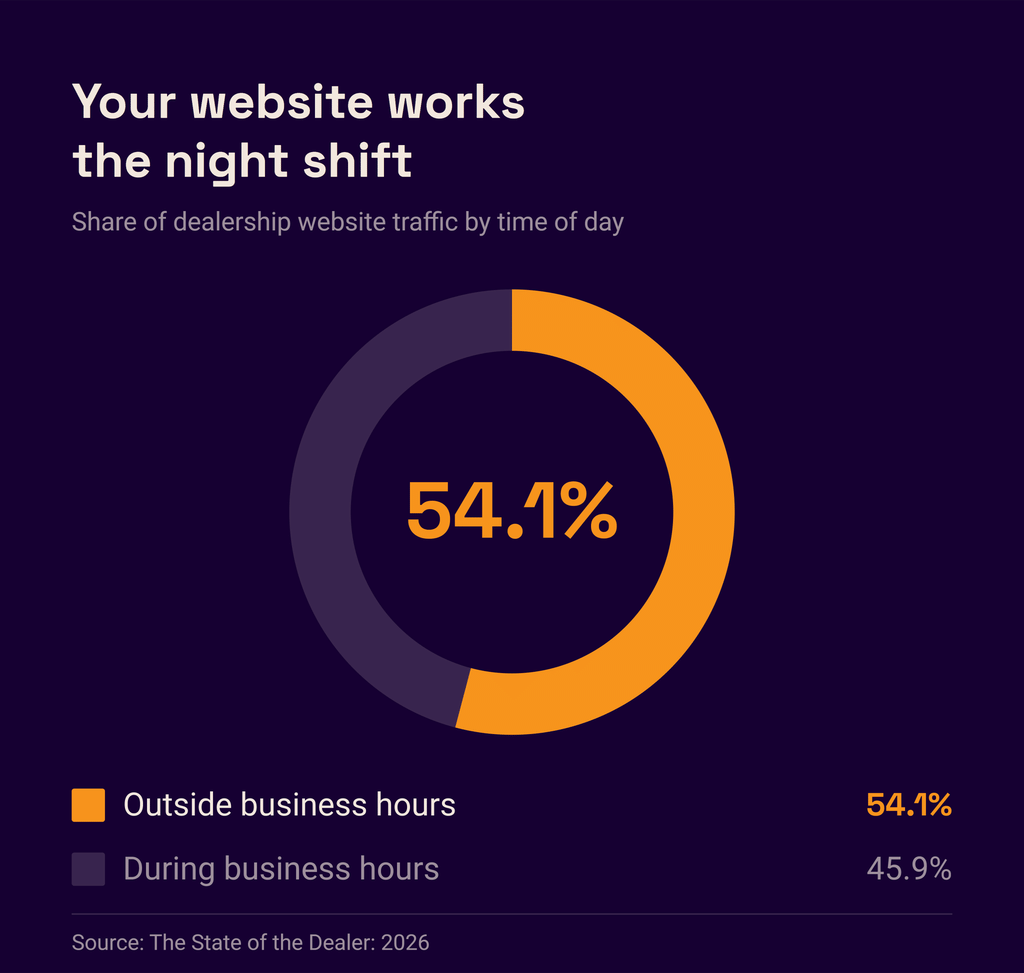
More than half of dealership website traffic, 54.1%, happens outside business hours. Some of those visitors are shopping. A meaningful number are trying to find out what their current bike, boat, or machine is worth.
That person is not a sales lead. They’re an inventory lead, and most stores treat them identically.
A trade value request usually lands in the same bucket as “request more info” and gets worked by whoever is next up on the floor. In a market where sourcing is the hard part, that’s a misallocation of your best acquisition signal.
What better looks like:
- Put a trade value request on your site and answer it with a number. A real estimate range, emailed back, beats “someone will contact you.” The shopper is deciding whether to sell. Give them something to decide with.
- Route it to whoever buys inventory. Your used manager or GM should see every online trade request daily, in one log, not scattered across inboxes.
- Read the pattern, not just the lead. If 12 trade requests come in for the same three model years, that’s a demand signal about your local market. Your competitors don’t have it.
For powersports dealers, pricing and trade-in tools built for the vertical can file those online estimates straight into an appraisal log, so nothing sits waiting for someone to notice it. Marine and heavy equipment dealers can run the same play as a repower or fleet conversation starter.
How do you get your whole team to the same appraisal number?
Ask three people at your store to appraise the same trade and you may get three answers. The front counter works one way. Service works another. Someone’s referencing a printed book that’s a quarter behind. The number ends up on a sticky note.
That isn’t a knowledge problem. Your people know these units. It’s a consistency problem, and consistency is what protects margin when a unit gets bought by whoever happens to be standing there.
Four things to write down:
- A fixed comp set, checked every time. Book value, wholesale or auction value, and live local retail listings. On used units, local comps matter more than national averages, beca
- Standing reconditioning deductions by category. Every used ATV needs tires. Every used boat needs a lower unit service. Set that number once per category and deduct it automatically. The offer stops depending on who’s feeling optimistic.
- A documented walkaround order. Same sequence, same checklist, every unit. Flaws you find during appraisal are negotiating room. Flaws you find after you own the unit are a write-down.
- One log. If the appraisal lives in a notebook, the next person redoes the work.
There’s a revenue angle most stores miss here too. The recon list you build during appraisal is a parts and labor work order. Units you buy generate service revenue before they generate sales revenue, and appraisal is where that gets scoped.
Dealer Spike’s internal findings, across a pool of more than 2,000 dealers over 12 months, show that dealers using inventory pricing and trade-in evaluation tools move units 39.8% faster than dealers who don’t. Speed follows consistency.
How should you price a used unit for your local market?
The spread between wholesale and retail is where your opportunity sits, and it isn’t uniform across your lot. In 2026, high-horsepower tractors held a healthy spread while heavy truck values slid. One buying strategy won’t serve both.
Two habits separate dealers who price well:
They price against the local market, not against the unit’s cost. A shopper comparing three comparable units within driving distance has no idea what you paid, and no reason to care. Days on market for similar local listings tells you more than your floor cost does.
They look at all their data in one view. Reconciling a book, an auction site, and a marketplace search across 20 browser tabs is how pricing decisions get postponed. Postponed pricing decisions become 90-day units.
One gap to check in whatever tools you use: most pull book and auction data but skip the places consumers shop. Seeing marketplace and classified listings alongside J.D. Power and NPA values gives you the number your customer is comparing you to, which is the number that decides whether your unit gets a call.
How do you merchandise a used unit that’s one of a kind?
This is where used inventory stops behaving like new inventory.
When you list 10 of the same model, the listing sells the model. When you list one used unit, the listing sells one specific object with a history, and shoppers know it. They arrive with a different set of questions: What’s wrong with it? Who owned it? When was it last serviced? What’s been replaced?
Among the top 50 dealers by inventory turn, 83.31% of units include pricing and 72.1% carry at least one image, averaging 10.2 images per unit. More than half of all browsing happens on mobile.
Consistency across those listings does more work than most dealers expect. As Shawntia Anderson, Customer Success Supervisor at Dealer Spike, puts it: “You wouldn’t want to walk into a dealership where half the units are clean and half are dusty. The same standard should apply to your listings.”
Here’s the checklist for a complete used unit listing:
- Mileage or engine hours, stated plainly
- Service history performed at your store, with dates
- Parts replaced and when: tires, belts, batteries, impellers, filters
- Reconditioning completed before the unit was listed
- Known cosmetic flaws, named and photographed
- What’s included: keys, manuals, accessories, cover, trailer, remaining warranty
- Ownership context where you have it: one owner, off-lease, trade from a repeat customer
Now the part that feels backward: naming the flaws helps the unit sell faster. A scratch you disclose is a negotiation you’ve already had. A scratch a shopper spots in your photos is a trust problem you’ll never hear about, because they just leave. Disclosure also filters out the calls that were never going to close.
Your used photo shot list should go past the beauty shots: odometer or hour meter, VIN or serial plate, tires and tread, seat and upholstery, hull and deck or undercarriage, and a close-up of every flaw you disclosed.
If 10 photos per unit sounds unrealistic for a team that’s already stretched, it’s less of a lift than it sounds. “You don’t need a photographer with a fancy camera,” says Abby Panfil, Customer Success Supervisor at Dealer Spike. “A smartphone and good natural light is usually fine. What matters more than camera quality is photo variety and consistency.” The dealers who keep it up make photos part of intake, shot the day the unit lands, so it never becomes a project someone has to schedule.
For more tips, run a few units through this inventory merchandising checklist.
Should you show your pricing and your fees on the listing?
Start with what shoppers do. “Request a price” is one of the most-submitted lead forms. Price is the first question, and a listing without one sends the shopper somewhere else to find it.
Then there’s the pressure building around disclosure. Expectations for total-price and fee transparency are tightening, federal guidance is still unsettled, and several states have moved further than others. Some dealers have absorbed real cost over fees that weren’t listed. Requirements vary by state, so confirm what applies to yours.
The practical move is the same either way: document the fee stack that applies to a used unit, and show how your advertised number becomes an out-the-door number. Doc fees, freight where it applies, setup, title. Shoppers who understand the number stop treating it as a trap.
If you’re weighing full price display against leaving room to negotiate, five dealerships worked through that exact debate and landed in different places for defensible reasons.
When should you reprice an aging unit, and when is price not the problem?
Everyone says reprice aging inventory. Almost nobody tells you how to figure out what’s wrong with the unit.
Benchmarks first. Used inventory should turn three to six times a year, against two to four for new. Only 20.92% of a top-turning dealer’s stock sits past 90 days.
Now the diagnostic. Pull views and leads for each aging unit and sort into four groups:
- Views up, leads flat. A pricing or transparency problem. The listing is getting seen and rejected.
- Views down, leads flat. A merchandising and distribution problem. Photos, title, description, or syndication. Not price.
- Views up, leads up, nothing closing. A response time and follow-up problem.
- Views dropped off after a strong start. The unit has gone stale in search and needs refreshed content, not a markdown.
Cutting the price on a unit nobody has viewed is the most common and most expensive mistake in a used department. You gave up margin to fix a problem you didn’t have.
Build a 15-minute weekly review by days on lot: 0 to 30, 31 to 60, 61 to 90, and 90 plus. Every band requires a decision, even if the decision is hold. The discipline is that the review happens every week, not that the markdowns are big.
One more thing to watch: if your website, your Google listing, and your marketplace feed disagree about price, mileage, or condition, the shopper resolves the conflict by leaving. That’s the silent sales killer, and it’s worth an audit.
How many ways should a shopper be able to take the next step?
Dealers using digital retailing tactics such as unit-page payment calculations generate 47.9% more high-quality leads.
The reason is simple. One catch-all contact form asks every shopper to take the same large step at the same moment, whether they’re 30 days out or ready tonight. A cluster of self-service options lets each person take the step they’re ready for: calculate a payment, get a trade estimate, schedule a test ride, get prequalified without a credit pull.
Three things that make the difference:
- Put them on the unit page. That’s where intent is highest. A homepage payment calculator is a missed opportunity.
- Set your own rates and terms for new, used, and promotional financing. A payment estimate that falls apart at the desk costs more trust than no estimate at all.
- Route and follow up by form type. Prequalification is an F&I conversation. A trade estimate is an acquisition conversation. A test ride is a calendar commitment. Treating all three the same throws away the signal the shopper just gave you.
Remember the 54.1%. After hours, self-service is the only thing working. See how digital retailing tools and payment calculators fit on the unit page.
How do you answer a shopper’s questions before they leave to search?
A shopper with an unanswered question about your used unit opens a new tab. Sometimes they come back. Increasingly they get an AI-generated answer assembled from somebody else’s listing and never return.
So answer the question where the question happens. Write the way your counter talks: the answer first, one detail that builds trust second, the next step third. “Does this come with a warranty?” gets a plainer answer on the unit page than it does three clicks deep in a FAQ archive.
The same completeness pays twice. Incomplete pricing fields and thin descriptions don’t only cost conversion, they cost visibility at the discovery stage, because an AI answer has nothing from your site to cite. Tools that answer unit-specific questions on the page pull from your own inventory data, which means your data quality sets the ceiling on how well they work.
For the mechanics, use the dealer FAQ playbook and this breakdown of AI and SEO.
How do you market a unit you only have one of?
Used inventory rewards different marketing than new.
Organic search.
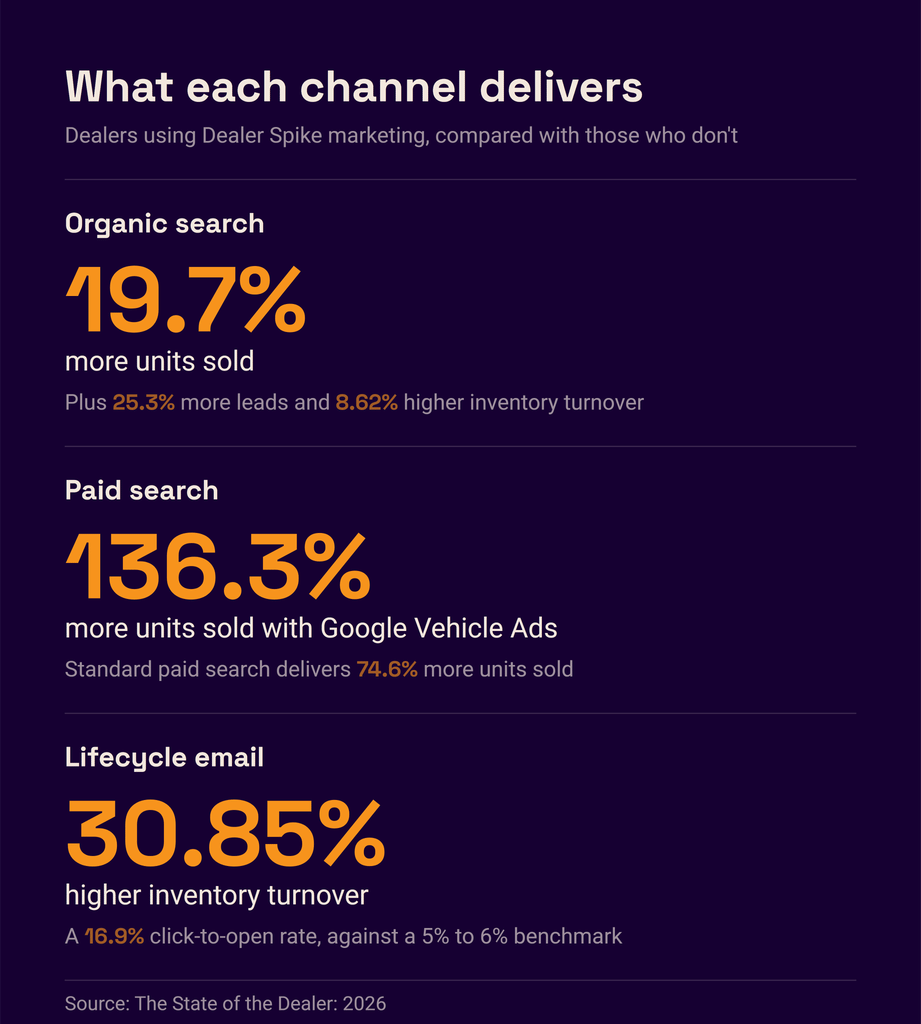
Used units are long-tail gold. A specific year, make, model, and trim search has a fraction of the competition of a new model term, and there’s exactly one of that unit at your store. Description quality is worth more on used than new for this reason. Across the Dealer Spike base, SEO delivers 8.62% higher inventory turnover, 19.7% more units sold, and 25.3% more leads.
Paid search.
Cost-per-click has gone up, while click-through and conversion rates dropped. Track cost per inquiry and cost per conversion, not clicks, or you’ll misread what’s working. High CPCs with low lead counts covers what to do about it. Google Vehicle Ads drive 136.3% more units sold, and paid search drives 74.6% more.
Lifecycle email.
This is the most underused lever on used inventory. At any given moment only a small slice of your list is actively shopping, so behavior-triggered email is how a one-of-one unit stays in front of the person who viewed it twice in March. Automated Email Marketing delivers 30.8% higher inventory turnover with a 16.9% click-to-open rate, against a 5% to 6% industry benchmark.
As Mark Sheffield of Woods Cycle Country puts it, today’s tire kickers are next spring’s buyers. Your list is where you keep them.
Syndication.
Make sure the unit says the same thing everywhere it appears. Inventory syndication handles the distribution, but the data has to be right at the source.
What does good look like on used inventory?
Run your own store against this list:
- Every used unit has a price, 10 or more images, and stated mileage or hours.
- Known flaws appear in the listing, not in the walkaround.
- One appraisal standard, one log, standing recon deductions by category.
- Online trade estimate requests reach the person who buys inventory the same day.
- Aging stock gets reviewed weekly by days-on-lot band, with a decision at every band.
- Fewer than a quarter of units have been sitting past 90 days.
- A shopper can get a payment, a trade number, or an appointment at 10 p.m. without talking to ayone.
The payoff for systematizing this is measurable.
Across a pool of more than 2,000 dealers over 12 months, Dealer Spike found that dealers using inventory pricing and trade-in evaluation tools saw 50.8% higher inventory turnover, 263% more used units sold, and 39.8% faster time to sale than dealers who don’t.
In 2027, the dealers who command their market won’t be the ones who marketed used inventory hardest. They’ll be the ones who bought it better and made it easy to trust.
For the benchmarks behind this guide, including what the data shows for your vertical, read The State of the Dealer: 2026.